
How Do Robots Work? Sense, Think, Act Explained
Last reviewed 18 October 2026
Published 16 October 2026.
The Short Answer
A robot works by sensing its surroundings with sensors, processing those readings with a programmed controller, and acting on the result through motors and actuators - then repeating that loop over and over, far faster than a person could react. Sense, think, act. Everything else is detail.
That loop is also the test for what counts as a robot. A washing machine runs a timer: it does the same spin whether the drum is full of towels or empty, because nothing is measuring the load and changing the plan. A robot vacuum takes a reading, decides something, and moves differently as a result - so it qualifies. Three conditions: it senses, it decides, it acts physically on the world.
The Three-Part Loop Every Robot Runs
Sensing is the input. Thinking is the maths in the middle. Acting is the output - something physically moves.
The part people underestimate is how often that cycle runs. Low-level motor control loops commonly run in the kilohertz range (thousands of cycles per second), while the higher-level decisions - which way to turn, where to go next - typically run far slower, often only a handful of times a second. A robot is not one loop. It is fast loops nested inside slow ones.
Keep that picture in your head and the rest of this article hangs together.
Step 1: Sensing - How a Robot Takes In the World
A sensor is a device that converts a physical quantity into an electrical signal. That is the whole job. Light becomes voltage, pressure becomes voltage, rotation becomes a train of pulses.
Then one plain sentence covers the handoff: the sensor produces a varying voltage, and the controller converts that voltage into a number it can do maths with. That conversion is called analogue-to-digital conversion, and it is why a robot can "compare" a distance to a threshold at all. Until it is a number, it is just electricity.
Different sensors answer different questions, and good robots carry several that overlap. Cameras are rich but easily fooled by glare. Bump switches are dumb but almost never wrong.
Common Robot Sensors and What Each One Measures
| Sensor | What it measures | Typically found in |
|---|---|---|
| Camera | Light and colour patterns (vision) | Robot vacuums, inspection robots, self-driving vehicles |
| Lidar | Distance, by timing reflected laser pulses | Mapping vacuums, autonomous vehicles, survey robots |
| Ultrasonic sensor | Distance, by timing a reflected sound pulse | Hobby robots, parking sensors |
| Infrared cliff sensor | Whether the floor is still there | Robot vacuums (stops them diving down stairs) |
| Bump switch | Contact - a simple yes or no | Vacuums, mowers, low-cost mobile robots |
| Encoder | How far and how fast a wheel or joint turned | Nearly every driven wheel and industrial joint |
| IMU / gyroscope | Tilt, rotation and acceleration | Drones, legged robots, balancing robots |
| Force and torque sensor | How hard the robot is pushing or gripping | Collaborative arms, assembly and polishing robots |
| Temperature sensor | Heat in motors, batteries or the workpiece | Welding robots, battery packs, industrial systems |
Encoders deserve a special mention because they are the quiet hero. Without one, a robot has no idea whether a command to turn moved anything at all. It is the difference between telling a wheel to spin and knowing that it did.
Step 2: Thinking - The Controller and Its Program
The controller is the computer. On a small robot that is usually a microcontroller - an Arduino-class board, say - a single chip that does one program, forever, with no operating system to get in the way.
Bigger robots need more. A Raspberry Pi or a small industrial PC can run vision, mapping and planning at once, often using ROS (the Robot Operating System), a software framework that lets separate programs on a robot pass messages to each other. Factory machines frequently use a PLC, a ruggedised industrial controller built to run the same logic reliably for years.
Here is the part that gets mythologised. The program is a set of rules, not a mind. "If distance is less than 20 centimetres, stop and turn right" is a rule. Stack a few thousand rules, some of them learned from data rather than typed by hand, and the behaviour looks clever. The machine is not thinking about your lounge. It is comparing numbers.
What a Control Loop Does (Feedback Explained Simply)
A control loop is the trick that makes the difference between a command and a result. Take a drive wheel. The target is 200 rpm. The encoder reports 180 rpm. The error is 20 rpm, so the controller nudges the voltage up, re-measures, and nudges again.
That constant measure-compare-correct cycle is a feedback loop, and the most common recipe for it is PID control. Three ingredients:
- Proportional - react in proportion to how big the error is right now. Big miss, big correction.
- Integral - watch the error that has been quietly accumulating and clear it, so a wheel does not sit forever just short of target.
- Derivative - watch how fast the error is shrinking and ease off early, so the robot does not overshoot and oscillate.
Tune those three badly and your robot wobbles, hunts, or screams its gearbox. Tune them well and it glides. Nearly every smooth-moving robot you have ever seen owes that smoothness to feedback, not to raw power.
Step 3: Acting - Motors, Actuators and Movement
An actuator is anything that turns a control signal into physical movement. Motors are the familiar ones, but they are not the only option.
| Actuator | Best for | Trade-off |
|---|---|---|
| Brushed DC motor | Cheap, simple driving | Brushes wear out; less efficient |
| Brushless DC motor | Efficiency and long life | Needs more complex drive electronics |
| Servo motor | Holding a commanded position or angle | Limited travel on hobby types; costs more |
| Stepper motor | Precise, repeatable increments without feedback | Can lose steps under load; noisy and power-hungry |
| Hydraulic ram | Very heavy lifting - excavators, large arms | Needs a pump, hoses and fluid; messy and bulky |
| Pneumatic cylinder or gripper | Fast, light, repetitive gripping | Needs compressed air; hard to control mid-stroke |
Between motor and movement sits the gearbox, and gearing is the trade every builder learns the hard way. Gear down and you swap speed for torque - a motor that spins uselessly fast becomes one that can shift a load. Gear too far and your robot has all the grunt in the world and crawls.
How Do Robots Move? Joints, Degrees of Freedom and End Effectors
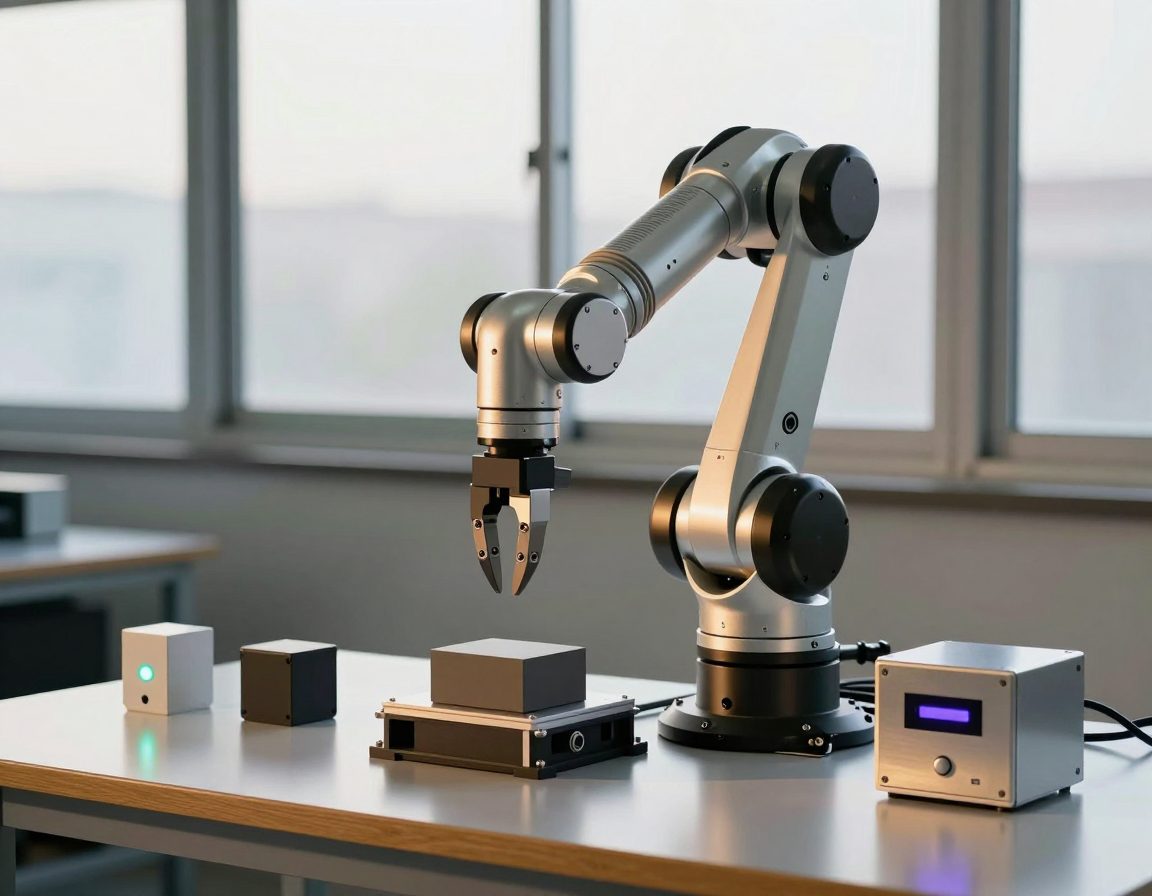
Degrees of freedom means the number of independent ways a robot can move. Your arm from shoulder to wrist is commonly counted as seven. A standard industrial robot arm has six, which is the minimum needed to reach any position within its workspace at any angle - three to get the hand to a point in space, three more to aim it.
At the end of the arm sits the end effector: the business end. Swap it and you change the robot's trade. A two-finger gripper for picking parts. Suction cups for cardboard and glass. A welding torch. A paint sprayer. A surgical instrument.
The arm is general-purpose. The end effector is what makes it a welder or a packer.
Where the Power Comes From: Batteries, Mains and Hydraulics
Mobile robots almost always run on lithium-ion packs, which is why your vacuum does a stretch of floor and then goes looking for its dock. Self-charging is not a luxury feature; it is how the machine survives its own power budget.
Factory robots usually dodge the problem entirely by staying plugged into mains power, bolted to a floor, with no battery to manage. Heavy hydraulic machines add a power pack - a pump and reservoir pushing fluid to the rams.
Power is the single biggest constraint on walking and flying robots. Legs and rotors burn energy continuously just to stay up, and every extra battery you add is extra weight those legs or rotors have to carry. That circular problem is why impressive demo footage is usually short.
Follow One Signal: A Robot Vacuum Hitting a Chair Leg
Abstractions are slippery, so let us follow a single real signal from end to end.
- The vacuum's front bumper presses against a chair leg. Inside, a mechanical switch closes a circuit.
- That closed circuit puts a voltage on one of the controller's input pins. The controller reads it as a digital 1 - contact.
- The program has a rule for a 1 on that pin: stop, reverse a short distance, rotate roughly thirty degrees, carry on.
- The controller sends that to the motor driver - a power board that sits between the fragile controller and the hungry motors - which reverses the polarity on both wheel motors.
- The wheels turn backwards. The encoders count the revolutions and report back, so the controller knows when the reverse distance has been covered on the floor rather than just commanded.
- One wheel then drives forward while the other holds or reverses, swinging the robot around. Encoders again confirm the turn.
- The bump pin reads 0. The cleaning behaviour resumes.
All of that happens faster than you can blink, and it happened a few hundred times during the last clean you did not watch. Sense, think, act - the same three steps, over and over.
Three Real Robots Taken Apart
1. The robot vacuum in your hallway
Mapping models use a spinning lidar or a camera to build a floor plan while working out where they sit inside it. That two-jobs-at-once problem is called SLAM - simultaneous localisation and mapping - and in plain English it means drawing the map and finding yourself on it at the same time, which is harder than either alone.
Underneath are infrared cliff sensors watching for stairs, bump switches, sometimes an optical dirt sensor that notices a grubby patch and triggers a second pass. Drive is differential: two independently driven wheels, so steering is just running one faster than the other. When the battery drops, it navigates back to the dock using the map it built.
2. The warehouse robot under the shelves
Fleet robots that carry shelving typically navigate using markers printed on the floor - fiducials, which are simply patterns a camera can recognise and decode, rather like a QR code - to keep track of exactly which grid square they are in.
The crucial part is that they are not independent. A central server runs traffic control for the whole fleet, allocating routes and intersections so two robots never want the same square at once. Load cells confirm a shelf is aboard. Emergency stops and defined safety zones exist because a loaded shelf weighing several hundred kilos does not stop politely.
3. The welding arm in a car plant
A six-axis welding arm is taught, not programmed in the everyday sense. A technician drives it through the path with a handheld teach pendant, saving waypoints, then the arm replays that path on every car body that arrives.
Repeatability is the headline spec: it returns to the same taught point within a fraction of a millimetre, every cycle, all shift. What it does not have is awareness. It has no model of the world beyond its stored path, which is exactly why these arms are caged - the safety comes from the fence and the interlocks, not from the robot noticing you.
How Are Robots Controlled? Pre-Programmed, Teleoperated and Autonomous
Three modes, and most real robots blend them.
Pre-programmed is the welding arm: a fixed, repetitive path with a tightly controlled environment doing the work that sensing would otherwise have to do.
Teleoperated means a human is the thinking part. Surgical systems, bomb disposal robots and remotely piloted craft put a person in the loop; the machine supplies steadiness, reach, scale or expendability, and the judgement stays human.
Autonomous means the robot chooses its own actions within rules someone set. Your vacuum picks its own route, but it did not choose to clean. A warehouse robot plans its own path within a route the server granted it.
Can Robots Think for Themselves?
No - not in the sense you mean when you say it about a person.
Machine learning does let a robot get genuinely better at a narrow task by finding patterns in data. That is statistical pattern matching, not understanding. A vision system can label a mug correctly ten thousand times without any concept of thirst, ownership, or what happens if it tips.
The strongest current example of something that looks like learned skill is reinforcement learning for locomotion: a legged robot practises in simulation, is rewarded for staying upright and moving forward, and converges on a gait nobody wrote by hand. Impressive, and still narrow - the policy learns to walk, not to decide where walking is worth doing. No goals of its own, no intentions, no grasp of meaning past its programming.
How Do Robots Act Without Being Told Every Step?
Because they are told the rules, not the steps. That distinction is the whole answer.
The common structures are state machines, where the robot is in exactly one mode at a time and defined events move it between them, and behaviour trees, where behaviours are arranged in a priority order and the tree ticks through them picking the highest one that currently applies. A vacuum's tree might read: if the cliff sensor trips, back off; else if bumped, turn away; else if lost on the map, relocalise - work out where you are again by matching what you can see to the map you stored; else keep cleaning.
Nobody wrote the route around your coffee table. They wrote the hierarchy that produces a route.
Where Did Robots Come From? A Short History
The word is younger than you might guess. It comes from Karel Capek's 1920 play R.U.R., from the Czech robota, meaning forced labour. So the word arrived from theatre, not engineering.
The hardware followed decades later. Unimate, the first industrial robot, went to work at a General Motors plant in 1961, doing hot and unpleasant handling work on a production line. In the late 1960s, Shakey at the Stanford Research Institute became the first mobile robot able to reason about its own actions rather than just execute them.
One correction worth making: Asimov's three laws of robotics are fiction. They were written as a plot device, not a safety standard, and no robot anywhere runs them. Real safety is fences, interlocks, speed limits, force limits and emergency stops.
How Do Robots Help Us in Everyday Life?
Mostly in places you do not look. Warehouse picking and sorting. Welding and painting car bodies. Surgical assistance. Harvesting and weeding on farms. Delivery trolleys in hospitals and distribution centres.
Then the jobs nobody wants: pipe and sewer inspection, bomb disposal, work inside radiation zones. And the ones no human can attend at all - planetary rovers operating tens to hundreds of millions of kilometres away, depending on where the two planets sit.
Closer to home, a vacuum and a robot mower. Modest, but the same loop.
Are Robots Better Than Humans?
At some things, overwhelmingly. Robots win on repeatability, endurance, precision, strength and tolerating hazards. A welding arm will hit the same point on shift three hundred without getting bored or sore.
Humans win on dexterity with unfamiliar objects, judgement in genuinely novel situations, and reading context. Hand a robot a job it has never seen, in a room nobody mapped, and it stalls.
This inversion has a name: Moravec's paradox. The things robots find hardest are the things a toddler does without thinking - folding a towel, picking up a ripe peach without bruising it, getting a sock the right way out. Chess fell to machines long before laundry did.
What Robots Still Cannot Do
Four limits that are widely acknowledged in the field, as we see it in 2026:
- Reliable general-purpose grasping. Known objects in known poses, fine. Reach into a cluttered drawer of unfamiliar items and success rates fall away.
- Common-sense reasoning about consequences. A robot can be told not to tip a mug. It does not independently work out that tipping it ruins the paperwork underneath.
- Operating safely in unmapped, cluttered human spaces. Robots do well where the world is structured for them. Your garage is not.
- Running long without charging or maintenance. Behind every long-running fleet is a charging schedule and a technician.
None of these are permanently closed problems. All four are open ones.
How to Build a Robot That Works: A Beginner Path
The sensible first build is small: a two-wheel differential-drive chassis, a microcontroller, a motor driver board, one ultrasonic sensor and a battery pack. Prices vary by retailer, so shop around rather than taking a figure from an article. For most people a first build is a weekend-sized project.
Write one behaviour only: drive forward until something is within twenty centimetres, then turn. Get that working end to end before you add anything. Then add one sensor at a time, testing after each.
Three mistakes sink most first attempts: an underpowered battery, so the pack sags under load and the controller browns out - loses enough voltage to reset mid-run; wiring motors straight to the board with no motor driver, which burns out the controller; and writing the entire program before testing a single part of it. Build the loop, then grow it.
How Robots Work, Explained for Kids
Short version for a younger reader: a robot has senses, a brain and muscles. Its senses are things like cameras for eyes and little feelers that notice a bump. Its brain is a tiny computer that follows rules someone wrote down. Its muscles are motors.
So it goes: notice something, check the rules, move. Over and over, really fast. That is it - no magic, and no robot deciding anything for itself.
A two-minute kitchen-table demo: one person is blindfolded as the "robot" and may only follow instructions given beforehand, such as "if your hand touches something, back up two steps and turn". Another person moves a cereal box into the path. The robot cannot adapt beyond its rules - which is exactly the point, and children usually spot it faster than adults do.
Frequently Asked Questions
How does a robot work in simple terms?
It senses, thinks and acts. Sensors convert something physical - distance, light, contact, rotation - into electrical signals. A controller turns those signals into numbers, compares them to rules in its program, and decides what to do. Motors and actuators then move something. The robot repeats that loop continuously while it is switched on.
What are the main parts of a robot?
Five: sensors to take in the world, a controller to run the program, actuators such as motors to produce movement, a power source such as a battery or mains supply, and a mechanical structure - the chassis, joints and end effector - that holds it all together and determines what movements are possible.
What is the difference between a robot and a machine?
A machine does what it is set to do. A robot senses its surroundings, makes a decision based on what it sensed, and acts physically. A washing machine runs a timer regardless of the load. A robot vacuum reads a cliff sensor and changes course. The sensing-and-deciding step is the line.
Do robots have brains?
They have controllers - microcontrollers, small computers or industrial PLCs - that run programs. A controller executes rules and maths extremely fast and reliably. It has no understanding, no intentions and no awareness of anything its sensors do not measure. Calling it a brain is a handy shorthand, not a description.
How do robots know where they are?
Several ways, usually combined. Encoders count wheel rotations to estimate distance travelled. IMUs track tilt and turning. Lidar or cameras compare what they see against a stored map, a process called SLAM. Warehouse robots often read markers printed on the floor to confirm their exact grid position.
What is a control loop in robotics?
A control loop measures the current state, compares it to the target, and corrects the difference - then repeats. If the target wheel speed is 200 rpm and the encoder reports 180, the controller raises the voltage and re-measures. PID control is the most common method, using the size, accumulation and rate of change of that error.
Can robots learn?
Within narrow limits, yes. Machine learning lets a robot improve at a specific task by finding patterns in data, and reinforcement learning can produce walking gaits nobody programmed by hand. But learning a skill is not understanding it. The robot has no goals of its own and no sense of meaning beyond its programming.
What is a degree of freedom?
One independent way a robot can move. A standard industrial arm has six degrees of freedom, which is the minimum needed to place its end effector at any position within reach at any angle. A human arm from shoulder to wrist is commonly counted as seven, which is why arms can reach around obstacles.
One Next Step
If this walkthrough made the sense-think-act loop click, the Daily Tech Wizard newsletter is the place to keep going - plain-English technology explainers written the same way: no jargon wall, no hand-waving, and no invented numbers. Subscribe and the next one comes to you.