What Is a Robot? Definition, Types and Examples
Last reviewed 18 October 2026
Here is the short version, and you can carry it around with you: a robot is a machine that can sense its environment, process what it senses to make a decision, and then physically act on the world - usually with some degree of autonomy, under programmed or learned control.
That is the definition. The useful bit is knowing how to apply it.
What is a robot? (the short answer)
Three things have to be true. It senses. It decides. It acts on the physical world. Miss one and you have something else - an appliance, a tool, a program, a toy.
Worth being honest about something the textbook pages gloss over: there is no single agreed definition of "robot". Roboticists argue at the edges, and they argue in good faith, because the edges are genuinely fuzzy.
The closest thing to an official line is ISO 8373:2021, the robotics vocabulary standard from the International Organization for Standardization. It describes a robot as a programmed, actuated mechanism with a degree of autonomy, moving within its environment to perform intended tasks. Note the three ideas tucked in there: actuation, autonomy, environment.
The three tests: sense, decide, act
Keep this checklist in your head and most arguments settle themselves.
- Sense - does it take in information about a changing world?
- Decide - does that information change what it does next?
- Act - does it move, grip, drive, cut or otherwise push on physical reality?
All three are required. A thermostat senses temperature and decides, but it has no body that acts on the world - it closes a relay and something else does the work. A remote-control car acts beautifully and decides nothing at all; you are the decision layer.
Test 1 - can it sense its surroundings?
Sensing means the machine is reading a world that changes while it works. A robot vacuum that bumps a chair leg and re-routes is sensing. A microwave counting down 90 seconds is not.
Test 2 - can it decide what to do?
This is the test people get wrong most often. "Decide" does not mean having opinions. It means the next action depends on the sensor reading, not just on a line number in a script.
Test 3 - can it physically act on the world?
No body, no robot. This is why a brilliant piece of software is not a robot, no matter how clever it sounds. Actuation is not optional.
Is it a robot? 12 everyday things, settled
- Robot vacuum (Roomba and friends) - yes. Senses with bump, cliff and often lidar sensors, decides a path, drives itself.
- Amazon warehouse drive unit - yes. Reads floor markers and fleet instructions, navigates, hauls shelving.
- Waymo robotaxi - yes. Perception, planning and steering all on board.
- DJI drone flying an autonomous mission - yes. Holds position, avoids obstacles, flies the route itself.
- Surgical system such as da Vinci - borderline. It acts with extraordinary precision, but the surgeon makes the decisions; it is teleoperation with assistance.
- Industrial welding arm - yes. It closes the loop on joint position every few milliseconds, and modern cells increasingly sense the seam and correct on the fly.
- Smart speaker - no. It senses (microphones) and decides (which answer to give), but it cannot act physically. Two out of three.
- Washing machine - no. Automated, not autonomous. It runs a cycle; it does not perceive a changing environment and change its mind.
- ChatGPT or an AI agent - no. No body, no actuators, nothing to push on.
- CNC machine - no. It follows a fixed toolpath with no sensing of the workpiece itself. Same fixed-path objection does not sink the welding arm, because the arm is built around continuous feedback and, in newer cells, vision.
- Animatronic figure - no. Puppetry on a timeline. Gorgeous engineering, zero decisions.
- Myoelectric prosthetic hand - borderline. It senses muscle signals, interprets them and actuates fingers. It passes all three tests, yet the intent is the person's, which is why most people call it a robotic device rather than a robot.
Where the word 'robot' comes from
The word was born in a play, not a lab. Karel Capek's Czech play R.U.R. (Rossum's Universal Robots) was written in 1920 and first performed in 1921.
The Czech root robota means forced labour, drudgery, the work a serf owes. Karel credited his brother, the painter Josef Capek, with suggesting the word.
Here is the twist most people miss: Capek's robots were artificial organic workers, grown rather than bolted together. The metal-man mental image arrived later, via pulp magazines and film.
Isaac Asimov then coined "robotics" in his 1941 story "Liar!" and laid out the Three Laws of Robotics in 1942's "Runaround". Those laws are fiction and have never been engineering practice - real machine safety comes from force limits, guarding and emergency stops, which we will get to.
How a robot works, step by step
The sense-think-act loop
Walk one machine through it and the abstraction disappears. Take a robot vacuum in a suburban lounge room.
It senses: bump sensors on the bar, cliff sensors watching for the step down to the hallway, wheel encoders counting rotations, and on better units a spinning lidar building a floor plan.
It decides: the controller compares where it thinks it is against the map, notices the lounge is done and the hall is not, and picks a turn.
It acts: motors drive the wheels, the brush spins, the fan pulls. Then the whole loop runs again - dozens of times a second, for the entire clean.
Sensors: the robot's eyes, ears and skin
- Cameras and depth cameras - vision, object recognition, shape
- Lidar and ultrasonic sensors - distance and mapping
- IMUs and gyroscopes - orientation, tilt, balance
- Encoders - exactly where each joint is
- Force-torque and tactile sensors - how hard it is gripping
- GPS - rough position outdoors
Every one of those is noisy. Sensor fusion is the maths that blends them so the robot can trust a messy world - lidar says wall, the IMU says you are tilting, the encoders say you have travelled 1.2 metres, and the estimate that comes out is better than any single input.
Controllers and software: the decision layer
Three broad control styles, in rising order of flexibility: fully pre-programmed paths, rule-based or reactive control, and learned control trained with machine learning.
Open-loop versus closed-loop in one go: an oven timer is open-loop - it runs 20 minutes whether your cake is done or not. Closed-loop means measuring the result and correcting, the way a thermostat measures, compares to a target and adjusts. Closed-loop control is necessary for a robot but not sufficient on its own; the thermostat still fails Test 3 because it has no body that acts on the world.
On the software side, ROS (Robot Operating System) is the de facto framework the field builds on, and SLAM - simultaneous localisation and mapping - is the technique that lets a machine build a map and work out where it sits in that map at the same time.
Actuators, motors and end effectors
Electric motors do most of the work. Servo motors for controlled position, stepper motors for precise increments, hydraulic actuators where you need brute force, pneumatics where you want speed and simplicity, and newer soft and shape-memory actuators for handling delicate things.
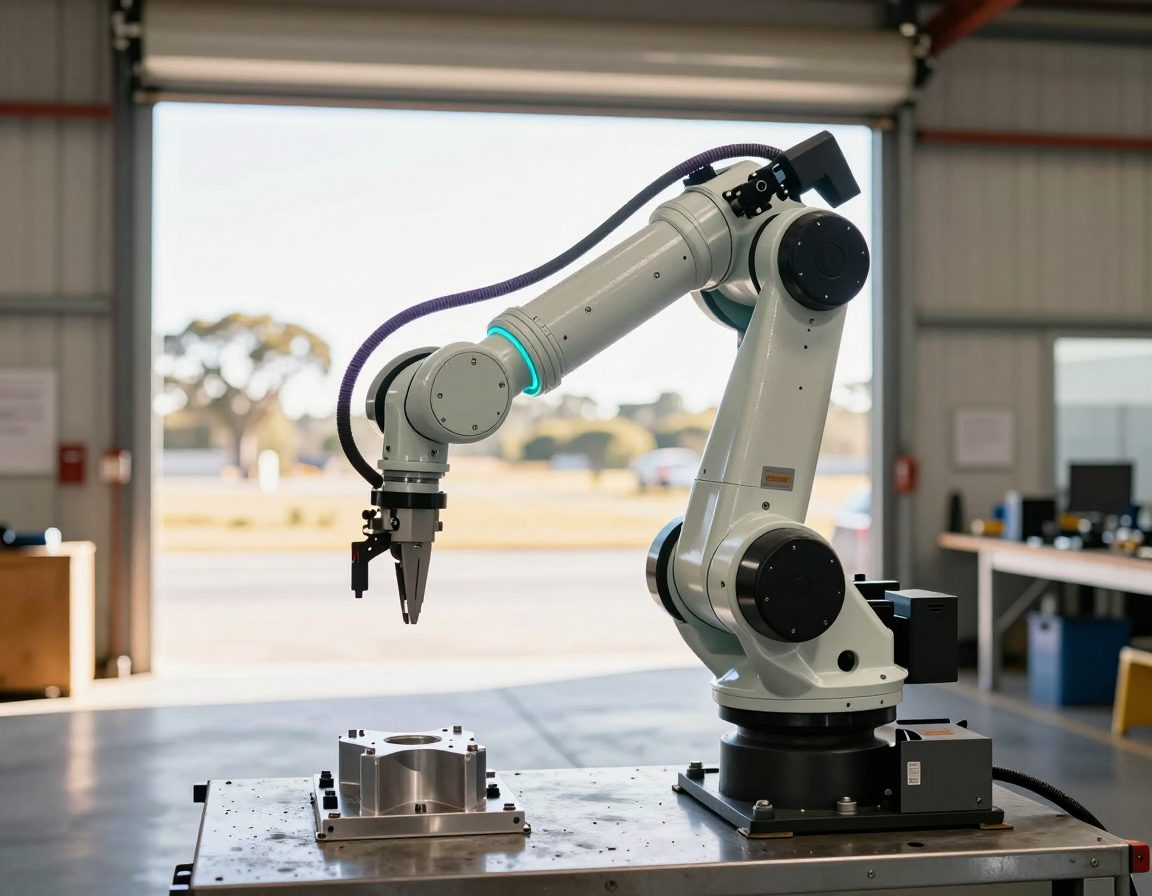
Degrees of freedom means the number of independent ways a machine can move. The canonical case is the six-axis industrial arm: six joints, so it can reach a position and an orientation anywhere in its working envelope.
The end effector is whatever is bolted to the wrist - the business end. Three common ones: a mechanical gripper, a suction cup for boxes and panels, a welding torch.
Power and the battery problem nobody mentions
Energy density is the quiet constraint, and it explains more of robotics history than any software breakthrough.
A warehouse arm plugs into mains power and runs all shift. A humanoid carries its energy on its back and measures runtime in hours, not days. That single fact is why factory robots were essentially solved decades ago while robots that walk around your house are still hard.
The main types of robots (with real examples)
Industrial arms and cobots
FANUC, KUKA and ABB arms do spot welding, palletising and machine tending behind guarding, at speeds fast enough to cause serious injury.
Collaborative robots - cobots, such as the Universal Robots UR series - are the softer cousin: slower, force-limited, designed to share a bench with a person rather than be caged away from one.
Mobile robots and AMRs
Autonomous mobile robots carry things through buildings. Warehouse fleets shuttle stock to pick stations, and hospital delivery robots run linen, meals and pathology samples between wards.
Humanoids and legged robots
Boston Dynamics Atlas and Spot, Agility Digit, Unitree's quadrupeds and Tesla Optimus get enormous attention. Be clear-eyed about it: as of 2026 humanoids are overwhelmingly pilots, demos and small deployments, not labour at scale.
Autonomous vehicles and drones
Waymo has been expanding driverless ride-hailing in the United States, and Zoox has been developing a purpose-built vehicle without a conventional steering wheel.
Drones do inspection, agriculture and delivery. In Australia, flying a drone autonomously beyond visual line of sight is not a free-for-all - CASA approvals govern it, which is a reminder that regulation, not capability, often sets the pace.
Surgical and medical robots
Systems like da Vinci translate a surgeon's hand movements into finer, steadier motion inside the body, filtering tremor and scaling the gesture. Teleoperated, not autonomous, and deliberately so.
Service and domestic robots
This is the category most readers already own something from: robot vacuums, robotic lawn mowers, window-cleaning units, restaurant server trolleys. If you want to see where the line between software and hardware is blurring fastest, the Daily Tech Wizard explainers on home automation and AI agents are the follow-on read.
Exploration deserves its own mention. NASA's Perseverance rover is still working on Mars; the Ingenuity helicopter that flew alongside it has finished its flight campaign. Deep-sea ROVs and AUVs do the same job underwater.
Software bots, RPA and AI agents: why they are not robots
This is the single biggest source of confusion in 2026, so let us be blunt.
Chatbots, RPA scripts, web crawlers and AI agents are all routinely called bots. None of them are robots under the three tests, for one simple reason: none of them physically act. They move data, not matter.
There is exactly one exception worth noting. The moment a software system drives actuators - a model that outputs motor commands, an agent that moves a real arm - it stops being just software and becomes the decision layer of a robot.
Can robots think for themselves?
No. Not today. No robot has general reasoning, goals of its own, or self-awareness.
What they do have is autonomy inside a task: choosing a route, adjusting a grip when something slips, re-planning around a pallet that should not be there. That is real, and it is genuinely useful. It is not thinking.
How much autonomy do today's robots really have?
A simplified ladder, borrowed in spirit from the SAE driving levels rather than being those levels:
- Teleoperated - a human drives it
- Assisted - a human drives, the machine corrects
- Conditional - the machine runs itself, a human is on standby
- Fully autonomous within a defined domain - no human in the loop, inside strict limits
Note that last phrase. "Fully autonomous" always comes with a fence around it. Large language models and vision-language-action models have made robots much better at interpreting instructions, which is why recent coverage sounds more dramatic than the underlying capability warrants.
What is robotics? The fields it pulls together
Robotics is the field. A robot is the artefact it produces.
It pulls in mechanical engineering, electrical and electronic engineering, computer science and software, control theory, AI and machine learning, computer vision, materials science, and increasingly human-robot interaction and safety engineering. That breadth is exactly why robotics is slow and expensive - you cannot be weak at any of it.
A simple definition for kids
A robot is a machine that can look at the world around it, work out what to do, and then move or do something about it.
A toy car you steer is not a robot. You are doing the thinking.
A vacuum that drives around the lounge on its own is a robot. So is a drone that flies a route by itself, and so is the big arm in a factory that picks up car doors.
Try this: walk around your house and count the robots. Most families find one or two, and a lot of arguments about the dishwasher.
Where robots are heading next
The credible near-term shifts, rather than the hype: warehouse and logistics automation is scaling fastest, cobots are spreading into smaller manufacturers, surgical robotics keeps growing on precision rather than autonomy, and agricultural robots for weeding and harvest are moving out of trials - relevant here, where broadacre cropping and robotic dairy systems have given Australian growers an early taste of it. Foundation models for robot control are the live research frontier.
The open problems are stubborn and well known: manipulating unfamiliar objects, reliability outside controlled settings, cost, battery life, and safety certification.
On responsibility, two things deserve saying. The workplace displacement debate is legitimate and should not be hand-waved. And human-robot collaboration safety comes from force and speed limits, light curtains, emergency stops and published standards - not from Asimov's laws, which were always a plot device.
Frequently asked questions about robots
What is the simplest definition of a robot?
A machine that senses its surroundings, decides what to do based on what it senses, and physically acts on the world. If any one of those three is missing, it is something else - an appliance, a tool or a piece of software.
Is a drone a robot?
Flying an autonomous mission, yes: it senses position and obstacles, decides a path, and actuates its motors. Flown manually stick-by-stick, it is closer to a remote-control aircraft, because you are supplying the decisions rather than the machine.
Is AI the same as a robot?
No. AI is software that can perceive patterns, reason or generate output. A robot is a physical machine. AI can be the decision layer inside a robot, but on its own it has no body and therefore cannot pass the act test.
Who invented the first robot?
The first industrial robot generally credited is Unimate, installed at a General Motors plant in 1961. It came from inventor George Devol's patent work, commercialised with Joseph Engelberger, who is widely called the father of industrial robotics.
What are the main components of a robot?
Five: sensors to perceive, a controller plus software to decide, actuators and motors to move, a mechanical structure or body, and a power source. Most robots also have an end effector - the gripper, suction cup or tool at the working end.
Can a robot feel pain?
No. Some robots have tactile and force sensors that detect pressure or damage and react by stopping or easing off. That is measurement and response, not sensation. There is no inner experience behind it, and nothing in current engineering creates one.
What is the difference between a robot and a machine?
Every robot is a machine; most machines are not robots. The difference is the sense-decide-act loop. A drill press does what you make it do. A robot takes in a changing situation and adjusts its own actions.
How many robots are there in the world?
The International Federation of Robotics publishes operational-stock figures for industrial robots each year in its World Robotics report. Rather than quote a number that dates within months, check the current edition directly - the global industrial stock runs into the millions and keeps climbing.
Where to read next
If you want the next wave of robotics explained without the breathless bits, keep reading the Daily Tech Wizard explainers - the pieces on AI agents and home automation are the natural next step, and they are where you can watch the line between software and robots blur in real time.