
What Is Quantum Computing? A Plain-English Guide
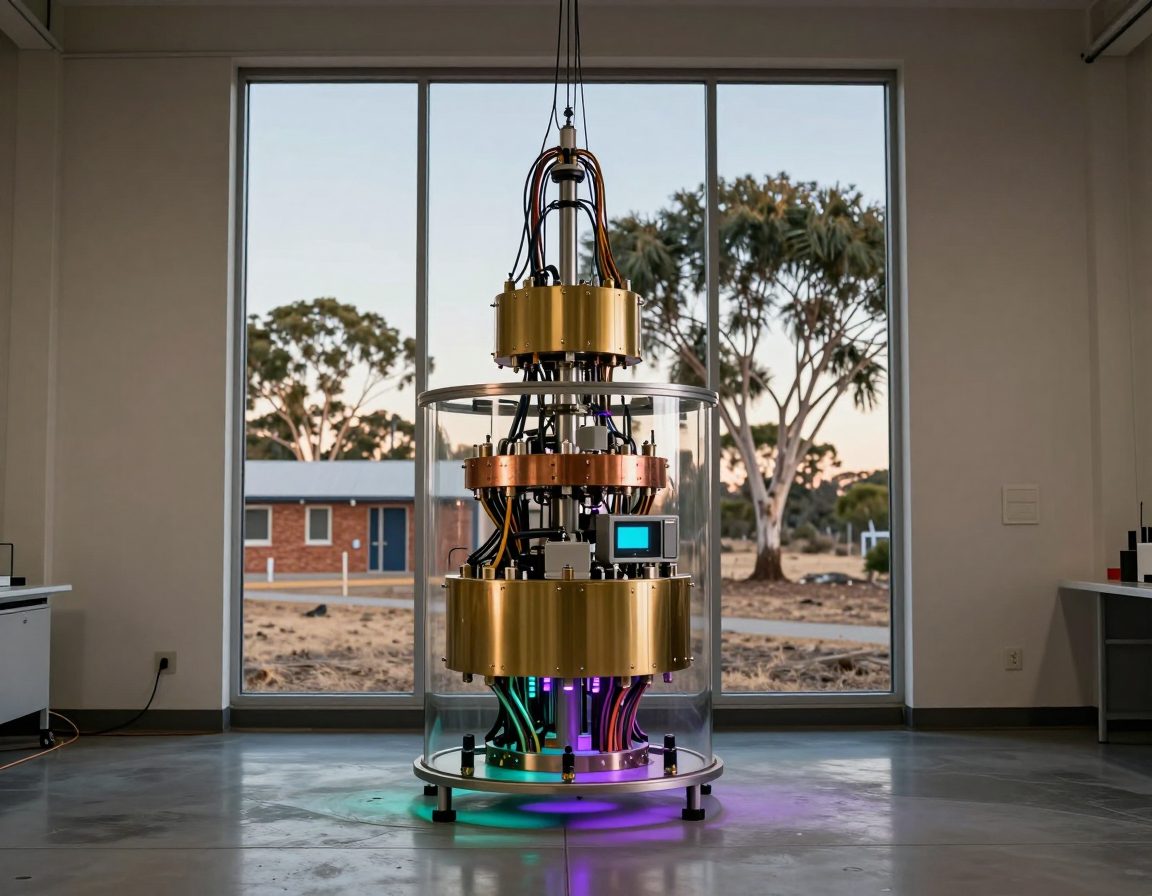
Quantum computing uses the laws of quantum mechanics to attack problems that are too complex for ordinary computers, swapping classical bits for qubits. That is the whole idea in one sentence.
Here is the part the ads leave out. Today, no quantum computer performs a useful task faster, cheaper or more efficiently than a classical computer, as AWS states plainly on its own explainer page.
So the machines are real. They are just not useful yet. This guide explains what they are, what they might eventually do, and - most usefully - how to read any quantum headline you come across without being taken for a ride.
What is quantum computing? The short answer
A quantum computer is a machine that stores and manipulates information using the strange rules that govern very small things - atoms, ions, electrons, particles of light. Instead of switches that are either on or off, it uses quantum states that can be both at once, and that can be linked to each other.
That lets a quantum computer explore an enormous number of possibilities inside one calculation. The catch is that getting a sensible answer back out is hard, and only works when someone has designed a clever algorithm for the specific problem.
If you want the dinner-table version: it is not a faster laptop. It is a specialist co-processor for a narrow class of maths problems that ordinary computers find brutal.
First, what a normal computer does
Your phone, your laptop, the eftpos terminal at the servo - all of them reduce everything to bits. A bit is strictly 0 or 1. Nothing in between, no maybes.
Underneath, tiny transistors flip those bits on and off billions of times a second. Every photo, song, tax return and video call is just an awful lot of 0s and 1s being shuffled very quickly and very reliably.
Classical computers are extraordinarily good at this. A quantum computer will not replace yours, and nobody serious is suggesting it will. There is no quantum laptop coming to Harvey Norman.
What is a qubit, and how is it different from a bit?
A classical bit is strictly 0 or 1. A qubit - a quantum bit - can be 0, 1, or both at once, and a group of qubits in that state spans 2 to the power of n possible combinations simultaneously, as IBM explains.
Work the numbers and it gets eye-watering fast. Ten qubits span 1,024 states. Fifty qubits span more than a quadrillion.
Now the caveat nobody puts in the headline: you cannot simply read all those states out. When you measure, you get one answer, not a quadrillion. That is exactly why a raw qubit count is a weak measure of how powerful a machine is.
How quantum computing works
Three ideas do the heavy lifting. Take them one at a time.
Superposition, explained without the maths
Flip a coin and watch it spin in the air. Mid-flight it is neither heads nor tails. That is the feel of superposition - a qubit holding both possibilities at once.
The analogy has limits, and they matter. A spinning coin is secretly already going to land one way; a qubit is not. Measuring it forces an outcome and collapses the superposition, which is why the answer is probabilistic.
Consequence: quantum programs are run many times over, and the result is a probability distribution you read patterns from. One run tells you almost nothing.
Entanglement, explained without the maths
Two qubits can be linked so tightly that they stop behaving like two separate things. NIST's explainer puts it in plain terms: entangled particles are always connected and have no independent existence.
Practically, measuring one tells you something about the other immediately. That lets a quantum circuit correlate its qubits so they behave as one system rather than a row of unrelated switches.
And no, entanglement does not let you send a message faster than light. You cannot control what the measurement gives you, so no usable information travels.
Interference: the part most explainers skip
This is the bit that produces the answers, and most explainers rush past it. A quantum circuit entangles qubits and generates interference patterns in which wrong answers cancel out and right answers get amplified - Microsoft's dictionary entry describes it the same way. What survives the cancellation is your solution.
Think noise-cancelling headphones, but for wrong answers.
Here is the implication that explains the entire state of the industry. A quantum computer is only useful when someone has designed an algorithm that makes the wrong answers cancel for that specific problem. There is no general-purpose quantum speed-up, which is why the list of known quantum algorithms is short.
How a quantum computer solves a problem, step by step
- Encode the problem. The question gets translated into the starting state of the qubits.
- Put the qubits into superposition. Now many possibilities are in play at once.
- Entangle them and apply quantum gates. Gates are the operations that make up a quantum circuit, arranged so the maths of your problem shapes the interference.
- Measure. Everything collapses to an ordinary classical bitstring - a plain string of 0s and 1s.
- Repeat, thousands of times. Build up the distribution, then read the pattern.
Worth knowing: the whole thing is driven by an ordinary classical computer, and researchers usually reach the hardware over the cloud rather than standing next to it.
Quantum computing vs classical computing: a side-by-side
- Unit of information: bit versus qubit.
- State: strictly 0 or 1 versus superposition of both.
- Scaling: add a bit, add one unit of memory; add a qubit, double the span of states (which you still cannot read out directly).
- Good at: everything you do daily versus a narrow set of simulation, optimisation and search problems.
- Operating conditions: room temperature versus near-absolute-zero refrigeration or atoms held in vacuum traps, depending on the qubit type.
- Error rates: transistors are famously reliable; qubit operations are not, by a wide margin.
- Maturity: decades of industrial refinement versus early research hardware.
The verdict is complementary, not competing. If quantum computing ever earns its keep, it will sit beside classical computing the way a specialist tool sits beside a good drill.
What are quantum computers used for?
Right now, mostly for research into quantum computers. The honest framing is problem classes, not products: AWS notes that quantum computers can offer a speed boost for specific classes including machine learning, optimisation and the simulation of physical systems.
Chemistry and materials
This is the most natural fit, and the reason is simple: molecules are themselves quantum systems. Simulating them on classical hardware means approximating quantum behaviour with maths that was never built for it.
Candidate targets include battery chemistry, industrial catalysts and early screening of drug candidates. Candidate, under active research - not deployed.
Optimisation and logistics
Routing a delivery fleet, scheduling shifts, packing containers. These problems explode in difficulty as you add options, which is why they come up constantly in quantum pitches.
Be careful here. Classical algorithms keep improving, and more than once an improved classical method has quietly erased a claimed quantum advantage.
Machine learning
Quantum machine learning is a live research area where quantum circuits are explored as a way of spotting structure in data. It overlaps with AI research, but quantum computing and AI are separate fields - the current AI boom runs entirely on classical chips.
Finance and chemistry: why they come up, and a caveat
Portfolio optimisation and risk simulation get named as candidate applications for the same reason logistics does: many variables, enormous numbers of combinations, and a tolerance for approximate answers.
To be clear, none of this is personal financial advice. Quantum computing is a research field, not an investment thesis, and this is general information only.
Are quantum computers faster than classical computers today?
No. Flatly no - and again, that comes from AWS itself, which states no quantum computer currently does a useful job better than a classical machine.
But you will have seen headlines claiming otherwise, so here is the nuance. Some demonstrations have a quantum processor complete a contrived benchmark that is genuinely hard to simulate on classical hardware. The benchmark is chosen precisely because it suits the machine.
A benchmark win is not a useful task. Several such claims have later been matched or beaten by improved classical methods. Learn that distinction - "hard to simulate" is not "commercially useful" - and you will read this field far better than most.
Why don't we have useful quantum computers yet? The error problem
Qubits are absurdly fragile. Heat, vibration and stray electromagnetic noise all knock them out of their quantum state, a process called decoherence. The delicate state does not last long by any everyday standard, and gate operations fail at rates far above anything a classical transistor would tolerate.
That, not qubit count, is the real bottleneck. NIST's explainer frames the whole "why don't we have them yet" question around exactly this fragility.
Quantum error correction and what "below threshold" means
The fix is quantum error correction: spread one unit of information across many physical qubits, so errors can be detected and corrected without ever reading the protected data directly.
"Below threshold" is the phrase to know. It means you have crossed the point where adding more physical qubits makes the encoded qubit more reliable rather than less. Above threshold, scaling up just adds more things to go wrong.
One concrete milestone anchors where the field sits. Google Quantum AI reported a below-threshold error-correction result in the journal Nature using its Willow chip, a two-dimensional array of 105 superconducting qubits, where enlarging the error-correcting code reduced the logical qubit's error rate - described as the first definitive demonstration of that on a real processor (Google Quantum AI).
Why it matters: it suggests the engineering path scales. It is not a working, useful computer, and Google does not claim it is.
Physical qubits vs logical qubits (the number that matters)
This is the single most useful concept in the whole article. The qubit counts in headlines are almost always physical qubits - individual, error-prone hardware components.
A logical qubit is the reliable, error-corrected unit a fault-tolerant machine would compute with, and building one is expected to take many physical qubits.
So whenever you see a qubit number, ask which kind it is. A machine with hundreds of physical qubits and a machine with hundreds of logical qubits are not in the same universe.
How to read any quantum computing headline: a 5-question filter
Screenshot this bit. Five questions, and almost every overblown quantum story falls over on at least one.
- How many qubits - physical or logical? If the article does not say, assume physical.
- Was the result error-corrected? Uncorrected results are interesting physics, not computing power.
- What exact problem was solved, and is it a benchmark or a real task? "Hard to simulate" is not "useful".
- What classical method was it compared against, and how hard did they try? A weak classical baseline makes any machine look brilliant.
- Is it peer-reviewed or a press release? Both can be legitimate. Only one has been checked by outsiders.
The different kinds of qubit being built
There is no agreed-upon winning design, and every approach trades one headache for another.
- Superconducting circuits: fast operations, but need to be chilled to near-absolute-zero.
- Trapped ions: individual atoms held in electromagnetic traps, prized for stability, generally slower to operate.
- Neutral atoms: atoms held with lasers, attractive for packing many qubits into an array.
- Photonic qubits: use particles of light, which resist some forms of noise but are fiddly to make interact.
- Silicon spin qubits: use the spin of electrons in silicon, with the appeal of borrowing the existing chip-manufacturing world.
That no architecture has clearly won is itself a signal of how early this all is. NIST's explainer covers the same field of contenders.
Where Australia fits in
Australia has a long-running research strength in silicon spin qubits, centred on work at UNSW and the spin-out company Silicon Quantum Computing. The CSIRO also runs a quantum technology program, and the federal government has published a National Quantum Strategy setting out its policy approach to the sector.
There are quantum research groups across other Australian universities too, including Sydney and Queensland, plus the Sydney Quantum Academy as a skills and training initiative. If you follow this in the news, those are the local names that recur.
Will quantum computers break encryption?
Eventually, possibly - and the concern is specific rather than general. A large, fault-tolerant quantum computer running Shor's algorithm could break widely used public-key cryptography such as RSA and elliptic-curve, which currently protects banking, messaging and ordinary web traffic.
No machine in existence is anywhere near that. Remember the logical-versus-physical gap.
The defence is already underway: post-quantum cryptography, a new generation of algorithms designed to resist quantum attack, is being standardised and rolled out across systems. Symmetric encryption and hashing - the workhorses behind things like disk encryption - are far less affected.
One phrase explains why organisations are migrating now rather than waiting: "harvest now, decrypt later". Encrypted traffic captured today could be stored and opened years later, so anything with a long sensitive shelf-life needs protecting ahead of time. For more on how this is playing out, follow our plain-English coverage of encryption and security news.
And no, we are not going to give you a date for "Q-Day". Anyone who does is guessing.
When will quantum computers be useful?
We will not give you a year, and here is why. Public roadmaps from the major builders are plans, not guarantees, and progress depends on error correction rather than calendars.
Instead, watch three observable signposts:
- Repeated below-threshold error correction at larger code sizes. Once is a result; repeatedly, at scale, is a trend.
- A demonstrated logical qubit that outlives its physical parts long enough to run a serious computation.
- A real commercial problem solved better than the best classical method - with the classical side given a genuine go.
Hit all three and the conversation changes. Until then, treat "the future is now" marketing as marketing. The field itself still calls this the NISQ era - noisy, intermediate-scale quantum - which tells you how its own researchers rate the hardware.
Does any of this affect you right now?
Honestly? Almost nothing changes for your day-to-day computing in the near term. No app, no phone, no ute's nav system is about to go quantum.
Two practical touchpoints are worth knowing. First, long-lived sensitive data: your bank, telco and government services will migrate to post-quantum cryptography, and you may see mentions of it in security notices. Second, quantum research keeps feeding adjacent areas such as quantum sensing and atomic clocks, which in turn support navigation and timing.
Common myths worth binning
- They try every answer at once and pick the right one. No - interference has to be engineered to cancel the wrong answers, and that only works problem by problem.
- They will replace your laptop or phone. They will not. Different tool, different job.
- More qubits means more power. Not if they are noisy physical qubits with no error correction.
- Entanglement enables faster-than-light messaging. It does not. No usable information travels.
- Quantum computing and AI are the same thing. Separate fields that overlap in some algorithm research. Today's AI runs on classical chips.
Quantum computing FAQ
What is quantum computing and how does it work?
Quantum computing uses the laws of quantum mechanics to tackle problems too complex for classical computers, using qubits instead of bits (IBM). A problem is encoded into qubits, which are placed in superposition, entangled and manipulated with quantum gates so interference cancels wrong answers and amplifies right ones. You then measure, repeat many times, and read the resulting pattern.
What is a qubit versus a bit?
A classical bit is strictly 0 or 1. A qubit can be 0, 1, or both at once, and a group of qubits in superposition spans 2 to the power of n combinations simultaneously (IBM). The important catch is that you cannot read all those states out - measurement gives you one outcome - so raw qubit counts are a poor measure of real computing power.
What are superposition and entanglement?
Superposition is a qubit holding both 0 and 1 at the same time, like a coin still spinning in the air, until measurement forces one outcome. Entanglement links qubits so they behave as one system rather than separate switches; NIST describes entangled particles as always connected, with no independent existence. Neither allows faster-than-light communication.
What are quantum computers used for?
Mostly research, for now. The problem classes where a speed boost looks plausible are machine learning, optimisation and the simulation of physical systems (AWS). That translates to candidate uses in chemistry and materials, logistics and scheduling, and risk-style modelling. These are active research directions rather than deployed commercial products.
Are quantum computers faster than classical computers?
Not for anything useful. AWS states that no quantum computer currently performs a useful task faster, cheaper or more efficiently than a classical one. Some demonstrations complete contrived benchmarks that are hard to simulate classically, but a benchmark is not a real task, and improved classical methods have matched several such results afterwards.
When will quantum computers be useful, and will they break encryption?
Nobody credible can give you a date, because progress depends on error correction rather than roadmaps. A large, fault-tolerant machine could eventually break RSA and elliptic-curve cryptography, but nothing today is close. Post-quantum cryptography is being standardised and rolled out now, largely because of the "harvest now, decrypt later" risk.
Key takeaways
- - Quantum computing uses quantum mechanics and qubits to attack problems classical computers cannot handle - it is a specialist co-processor, not a faster laptop.
- - Superposition and entanglement get the attention, but interference is what produces answers, and it only works when an algorithm is designed for that exact problem.
- - Error rates, not qubit counts, are the bottleneck. Ask whether a headline number is physical or logical qubits.
- - Google Quantum AI's below-threshold error-correction result on the 105-qubit Willow chip, published in Nature, is the concrete milestone to anchor against - a sign the engineering path may scale, not a working useful computer.
- - And the line worth remembering above all: today, no quantum computer performs a useful task faster, cheaper or more efficiently than a classical computer (AWS).
Get the plain-English version in your inbox
If you want quantum computing, AI and science news explained in plain English without the hype, join the free daily newsletter. One email a day, every story linked to its original source, and a real person approves every post before it goes out.
More reading: our archive of technology and science explainers.
Editorial note: Daily Tech Wizard links every story to its original source, and a real person reviews each post before publication. Factual claims in this guide are attributed to the named sources linked inline.