
Microsoft expects its new Maia 300 AI chip to deliver 40 percent more tokens per megawatt than leading GPU-based systems. That figure comes from Microsoft itself, via Scott Guthrie, executive vice president of its clo...
Microsoft expects its new Maia 300 AI chip to deliver 40 percent more tokens per megawatt than leading GPU-based systems. That figure comes from Microsoft itself, via Scott Guthrie, executive vice president of its cloud group.

Microsoft announced its third in-house AI chip. Maia 300 was announced October 12, with an efficiency claim attached.
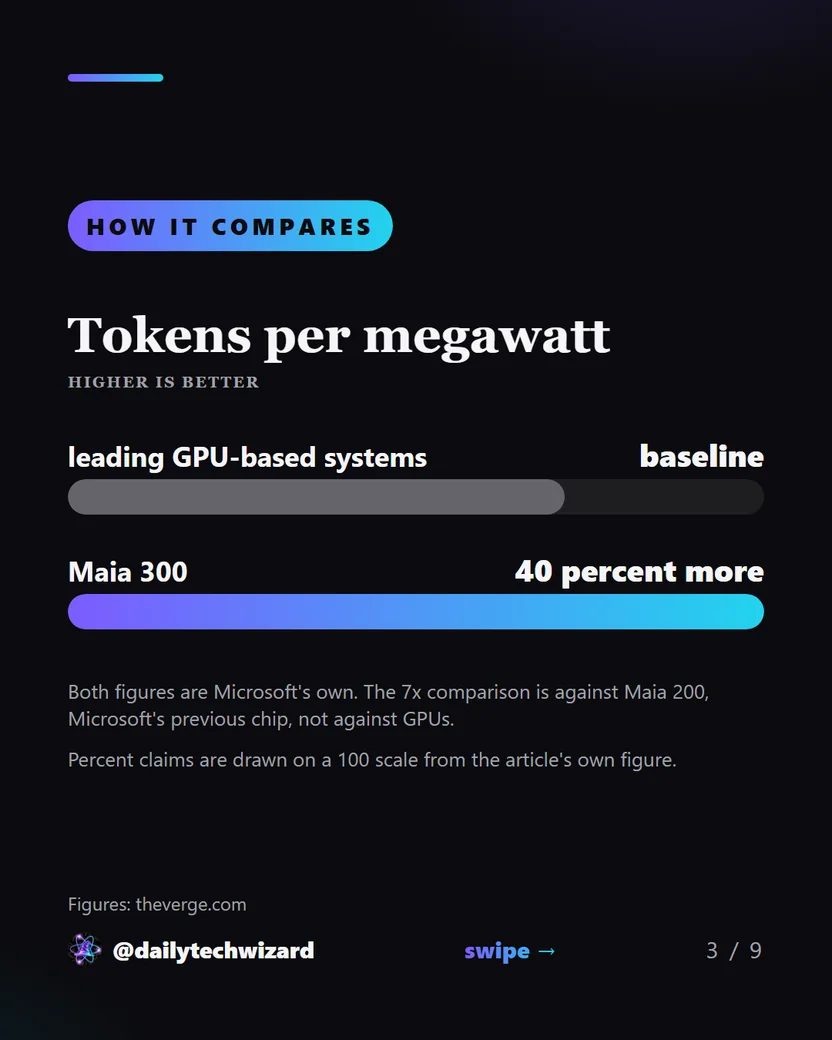
Tokens per megawatt: Maia 300 is 40 percent more than leading GPU-based systems. Both figures are Microsoft's own. The 7x comparison is against Maia 200, Microsoft's previous chip, not against GPUs.
40% more tokens per megawatt. Microsoft expects Maia 300 to deliver 40 percent more tokens per megawatt than leading GPU-based systems. Microsoft says so itself.
Up to 7x versus Maia 200. A full 96-accelerator configuration delivers up to 7x the rack-scale token throughput of Maia 200, Microsoft's previous chip, not GPUs.
Built for long reasoning and agents. Microsoft describes it as designed for long-context reasoning, latency-sensitive conversation, and sustained multi-step agentic tasks. It uses TSMC's N2P process.
Rollout starts in 2027. Maia 300 begins reaching production workloads in 2027, when Microsoft says it will start scaling Azure Maia to multi-gigawatt deployments.
Maia 200 already runs Copilot. Announced in January, Maia 200 runs production workloads including Microsoft Copilot, GitHub Copilot, Microsoft Foundry, and Microsoft's own AI models.
Microsoft describes Maia 300 as designed for long-context reasoning, latency-sensitive conversational experiences, and sustained, multi-step agentic tasks. It is built on TSMC's N2P process and uses a chiplet design that separates compute, memory controller, and I/O. Microsoft's Azure hardware and infrastructure team says that lets each function use the technology best suited to its role.
Maia 300 starts rolling out to production workloads in 2027. That is also when Microsoft says it will begin scaling the Azure Maia family to multi-gigawatt deployments, with Maia as the primary AI inference system for its products and services. The Verge reports the efficiency gains would let Microsoft rely mainly on its own chips instead of Nvidia's and AMD's.
Would you trust a company's own efficiency numbers on its own chip?