Lab-grown brain models head to space station for five weeks
Small lab-grown models of the human brain will spend five weeks on the International Space Station, while identical models stay on Earth.

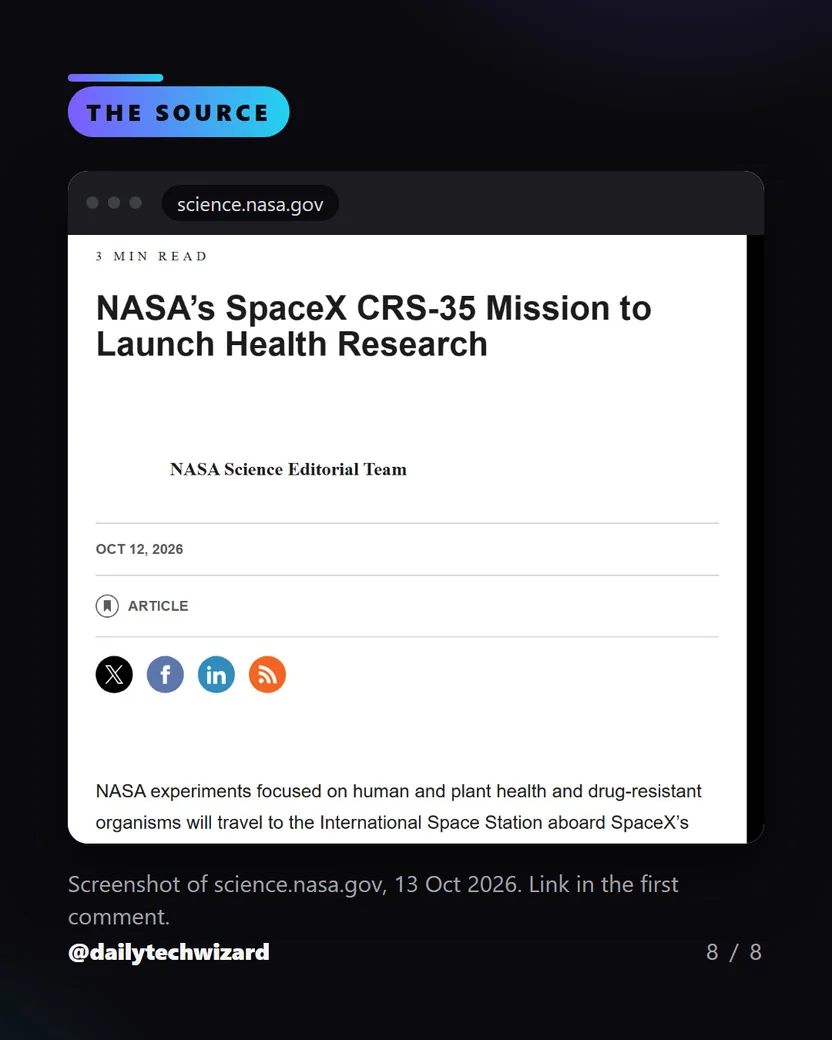
Lab-grown brain models are heading to the ISS. Four investigations ride SpaceX's 35th resupply mission.
Lab-grown brain models get five weeks in orbit. Identical models stay on Earth. Researchers will compare the two sets to see how short spaceflight affects the brain at the cellular level.
Plants infected with a fungus, grown in space. Researchers compare Earth-grown and station-grown plants to learn whether crop diseases develop faster and more severely in microgravity.
A compact plate reader gets its first test. The test checks whether it can detect and measure biomarkers like antibodies, antigens and proteins, which would let samples be analyzed on the station instead of back on Earth.
Station surfaces are sampled for drug-resistant organisms. This fourth and final planned stay studies how antibiotic-resistant bacteria survive and evolve in microgravity.
Researchers will compare the two sets to see how a short spaceflight affects the brain at the cellular level. The models ride on SpaceX's 35th Commercial Resupply Services mission, launching from Cape Canaveral Space Force Station in Florida. They are one of four investigations from NASA's Biological and Physical Sciences division, supporting astronaut health during long-duration missions.
A second study compares Earth-grown and station-grown plants infected with a disease-causing fungus. Researchers want to know whether crop diseases develop faster and more severely in microgravity. The findings could guide plant breeding on Earth for disease resistance and help minimize yield losses in future space agriculture.
The mission also carries the first test of a compact microplate reader that arrived at the station earlier this year. The experiment tests its ability to detect and measure biomarkers such as antibodies, antigens and proteins, which would allow scientists to analyze samples on the station instead of waiting for them to return to Earth.
The fourth investigation returns for its fourth and final planned stay. Astronauts repeatedly sample station surfaces to monitor for drug-resistant organisms. On Earth, the findings could provide insight into how superbugs develop from the overuse of antibiotics.
Which of these four experiments would you most want to see results from?