
SkyFall helicopters to scan Mars subsurface with radar
Three helicopters headed to Mars will each carry a ground-penetrating radar, and scientists say they will "show us parts of Mars we've never seen before."
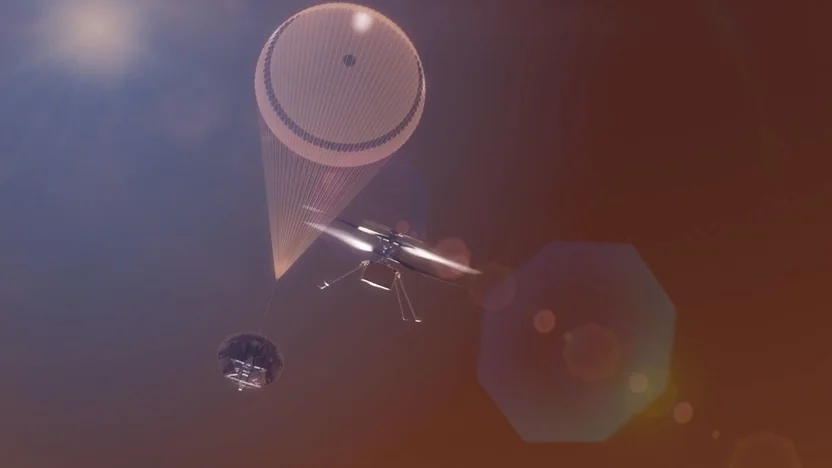
Three helicopters will scan under Mars. NASA's next Mars helicopters carry radar to look for buried ice, which matters for science and future human trips.
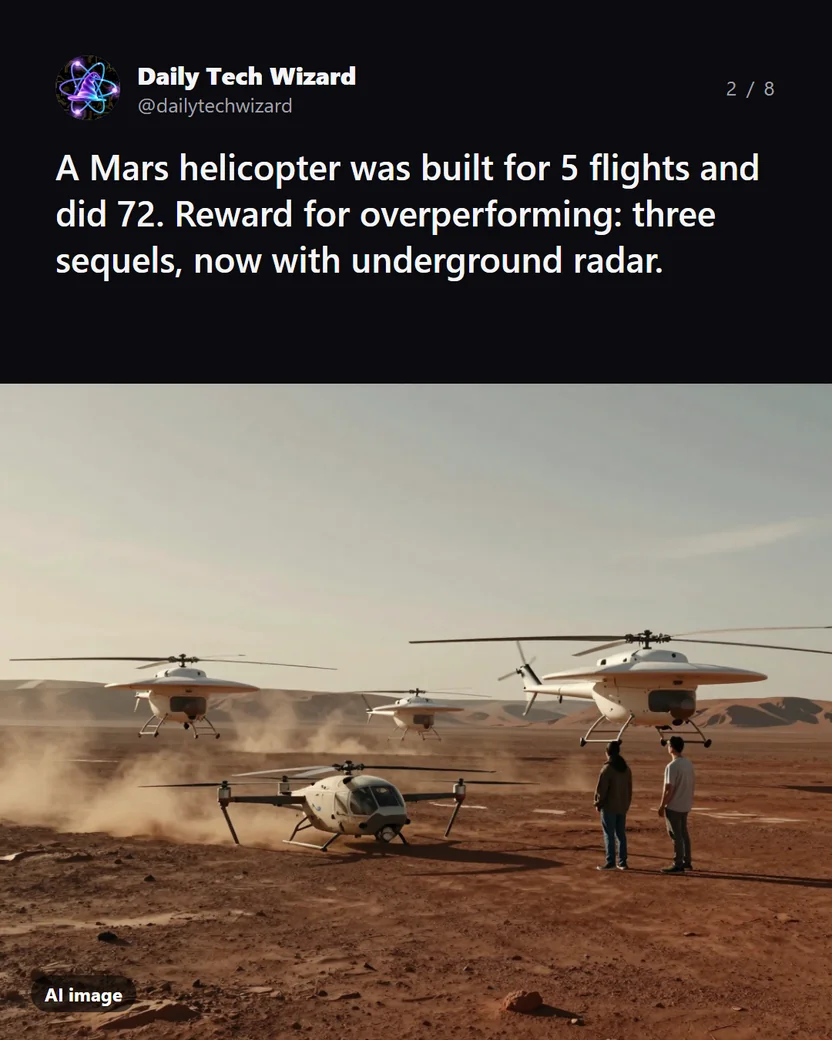
Radar that sees below the surface. Each of the three helicopters carries a ground-penetrating radar. It detects near-surface layering at depths orbital radar can't observe.
Why buried ice matters. Subsurface ice preserves a record of past Martian climate. It's also of interest for future human expeditions.
Built on Ingenuity's experience. Ingenuity was designed for five flights and flew 72 times at Jezero Crater. SkyFall's helicopters are slightly larger.
200 to 300 km possible. Each can fly one to two kilometers every other sol, so traverses of 200 to 300 kilometers (125 to 185 miles) are possible.
Launch slated for 2028, sites still open. Landing sites will be chosen after two workshops, in early and late 2027. The design reference site targets subsurface water ice.
The radar can detect layering in the near surface, at depths unobservable by orbital radar. Those layers could be rocky material, buried ice, or a combination. Near-surface ice is of interest both scientifically and in support of future human expeditions. Subsurface ice also preserves a record of past Martian climate, and is a "high-priority environment" that might have hosted life in the past, or still does.
The SkyFall helicopters build on Ingenuity, which flew 72 times at Jezero Crater before breaking a rotor. It was designed for five flights. SkyFall's helicopters are slightly larger, but project scientist Matthew Golombek of JPL said they are "being designed to operate in exactly the same way."
Launch is slated for 2028 aboard SR-1 Freedom, the first fission nuclear-powered interplanetary spacecraft. It will deliver the entry capsule to Mars' northern hemisphere in spring, to avoid dust storms. Each helicopter can fly one to two kilometers every other sol, so traverses of 200 to 300 kilometers are possible. They are designed to last six months, with a goal of one Earth year.
Would you want these helicopters to go after buried ice first?
Cover image: space.com