An AI agent that rewrites its own game-playing code earned 6 gold medals in a new competition-style test.
The approach is called Adversarial Heuristic Learning. The agent plays, studies what happened, and revises the executable policy and supporting software that play the game for it. The model's weights stay fixed.
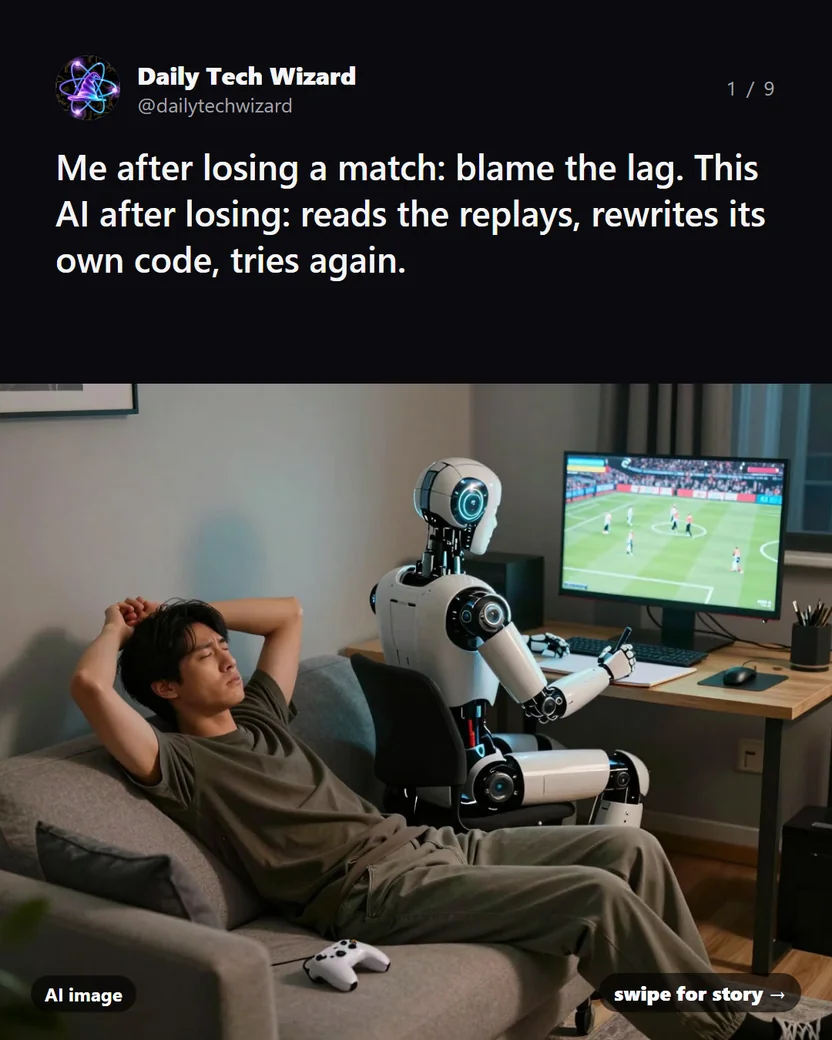
An AI agent rewrote its own game code. Claude Code with Opus 5.5 earned 6 gold medals in a competition-style test.
The agent revises its own code. It plays, studies what happened, and revises the executable policy and supporting software that play for it. The model's weights stay fixed.
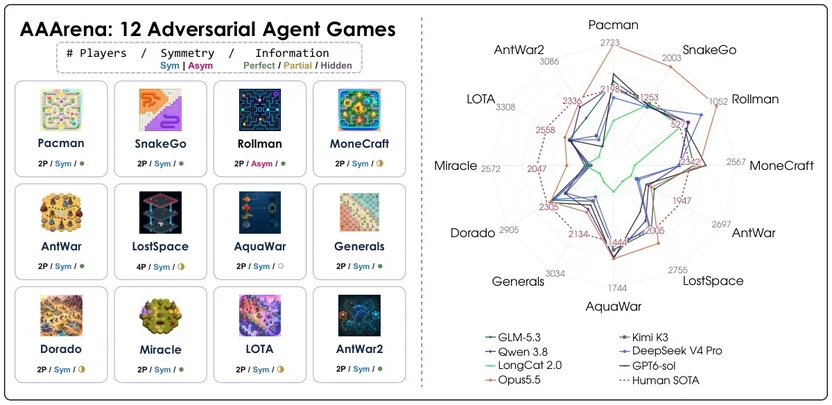
AAArena: 12 games, 1,920 human programs. AAArena is a benchmark of 12 authentic adversarial games and 1,920 archived human programs, modeled on real-world game competitions.
Opus 5.5 in Claude Code earned 6 golds. On the other 6 human ladders, no configuration the researchers evaluated came out on top.
Complex rules were generally harder. Performance was generally weaker in games with more complex rule specifications.
Agents learned from replays. Opponent selection and dense feedback both supported policy improvement. Agents learned from replays of their own matches and of other players' matches.
To test it, the team built AAArena, a benchmark of 12 authentic adversarial games and 1,920 archived human programs, modeled on real-world game competitions. Within fixed match and evaluation budgets, each agent reads the rules, picks its opponents, goes through replays, and revises its game agent to reach its highest ranking.
Agents can climb some human ladders by rewriting their own code.
Cover figure: Yang, Kaisen et al., arXiv:2610.12341, CC BY 4.0 (http://creativecommons.org/licenses/by/4.0/), https://arxiv.org/abs/2610.12341